
Page Summary
-
IMA SDKs enable easy integration of multimedia ads into websites and apps, supporting VAST-compliant ad servers and managing ad playback while you control content video.
-
Implementing IMA client-side primarily involves four SDK components: IMAAdDisplayContainer, IMAAdsLoader, IMAAdsRequest, and IMAAdsManager.
-
Prerequisites for integrating the IMA SDK include Xcode 13 or later and a dependency manager like CocoaPods, Swift Package Manager, or a manual download of the SDK.
-
The integration process involves creating a simple video player, importing the IMA SDK, implementing content playhead tracking, initializing the ads loader, making an ads request, and setting up delegates for both the ads loader and ads manager.
IMA SDKs make it easy to integrate multimedia ads into your websites and apps. IMA SDKs can request ads from any VAST-compliant ad server and manage ad playback in your apps. With IMA client-side SDKs, you maintain control of content video playback, while the SDK handles ad playback. Ads play in a separate video player positioned on top of the app's content video player.
This guide demonstrates how to integrate IMA SDK into a video player app. To view or follow along with a completed sample integration, download the BasicExample from GitHub.
IMA client-side overview
Implementing IMA client-side involves four main SDK components. This guide demonstrates these components:
IMAAdDisplayContainer: A container object that specifies where IMA renders ad UI elements and measures viewability, including Active View and Open Measurement.IMAAdsLoader: An object that requests ads and handles events from ads request responses. You should only instantiate one ads loader, which can be reused throughout the life of the application.IMAAdsRequest: An object that defines an ads request. Ads requests specify the URL for the VAST ad tag, as well as additional parameters, such as ad dimensions.IMAAdsManager: An object that contains the response to the ads request, controls ad playback, and listens for ad events fired by the SDK.
Prerequisites
Before you begin, you need the following:
- Xcode 13 or later
- Method for installing the IMA SDK:
- Preferred: Swift Package Manager
- A download copy of IMA SDK for tvOS
1. Create a new Xcode project
In Xcode, create a new tvOS project using Objective-C or Swift. Use BasicExample as the project name.
2. Add IMA SDK to the Xcode project
To install IMA SDK, choose a preferred method.
Recommended: Install IMA SDK using Swift Package Manager
Interactive Media Ads SDK supports Swift Package Manager starting in version 4.8.2. Follow these steps to import the Swift package.
In Xcode, install IMA SDK Swift Package by navigating to File > Add Packages....
In the prompt that appears, search for IMA SDK Swift Package GitHub repository:
https://github.com/googleads/swift-package-manager-google-interactive-media-ads-tvosSelect the version of IMA SDK Swift Package you want to use. For new projects, we recommend using the Up to Next Major Version.
Once you're finished, Xcode resolves your package dependencies and downloads them in the background. For more details on how to add package dependencies, see Apple's article.
Manually downloading and installing IMA SDK
If you don't want to use Swift Package Manager, download and manually add IMA SDK to your project.
Show/hide instructions
- From the tvOS IMA Download page, download and extract the latest version of tvOS IMA SDK.
- Open BasicExample.xcodeproj.
- In the left pane, click the project name.
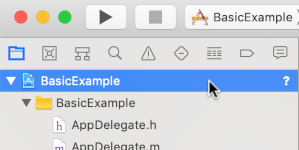
- In the center pane, click Build Phases.

- Expand the Link Binary With Libraries section.
- At the bottom of the libraries list, click the plus icon [+].
- Click Add Other.
- In the directory where you extracted the downloaded SDK, select GoogleInteractiveMediaAds.framework and click Open.
- At the bottom of the libraries list, click the plus icon [+] again.
- In the Status column, verify that
GoogleInteractiveMediaAds.frameworkshowsRequired. - Include the
-ObjClinker flag in your build settings. For more information, see Apple QA1490.
3. Import IMA SDK
Add IMA framework using an import statement.
Objective-C
#import "ViewController.h"
#import <AVKit/AVKit.h>
@import GoogleInteractiveMediaAds;
Swift
import AVFoundation
import GoogleInteractiveMediaAds
import UIKit
4. Create a video player and integrate IMA SDK
The following example initializes IMA SDK:
Objective-C
NSString *const kContentURLString =
@"https://storage.googleapis.com/interactive-media-ads/media/stock.mp4";
NSString *const kAdTagURLString =
@"https://pubads.g.doubleclick.net/gampad/ads?"
@"iu=/21775744923/external/vmap_ad_samples&sz=640x480&"
@"cust_params=sample_ar%3Dpremidpostlongpod&ciu_szs=300x250&gdfp_req=1&ad_rule=1&"
@"output=vmap&unviewed_position_start=1&env=vp&cmsid=496&vid=short_onecue&correlator=";
@interface ViewController () <IMAAdsLoaderDelegate, IMAAdsManagerDelegate>
@property(nonatomic) IMAAdsLoader *adsLoader;
@property(nonatomic) IMAAdDisplayContainer *adDisplayContainer;
@property(nonatomic) IMAAdsManager *adsManager;
@property(nonatomic) IMAAVPlayerContentPlayhead *contentPlayhead;
@property(nonatomic) AVPlayerViewController *contentPlayerViewController;
@property(nonatomic, getter=isAdBreakActive) BOOL adBreakActive;
@end
@implementation ViewController
- (void)viewDidLoad {
[super viewDidLoad];
self.view.backgroundColor = [UIColor blackColor];
[self setupAdsLoader];
[self setupContentPlayer];
}
- (void)viewDidAppear:(BOOL)animated {
[super viewDidAppear:animated];
[self requestAds];
}
// Add the content video player as a child view controller.
- (void)showContentPlayer {
[self addChildViewController:self.contentPlayerViewController];
self.contentPlayerViewController.view.frame = self.view.bounds;
[self.view insertSubview:self.contentPlayerViewController.view atIndex:0];
[self.contentPlayerViewController didMoveToParentViewController:self];
}
// Remove and detach the content video player.
- (void)hideContentPlayer {
// The whole controller needs to be detached so that it doesn't capture resume events from the
// remote and play content underneath the ad.
[self.contentPlayerViewController willMoveToParentViewController:nil];
[self.contentPlayerViewController.view removeFromSuperview];
[self.contentPlayerViewController removeFromParentViewController];
}
Swift
class ViewController: UIViewController, IMAAdsLoaderDelegate, IMAAdsManagerDelegate {
static let contentURLString =
"https://devstreaming-cdn.apple.com/videos/streaming/examples/"
+ "img_bipbop_adv_example_fmp4/master.m3u8"
static let adTagURLString =
"https://pubads.g.doubleclick.net/gampad/ads?iu=/21775744923/external/single_ad_samples&"
+ "sz=640x480&cust_params=sample_ct%3Dlinear&ciu_szs=300x250%2C728x90&gdfp_req=1&output=vast&"
+ "unviewed_position_start=1&env=vp&correlator="
var adsLoader: IMAAdsLoader!
var adDisplayContainer: IMAAdDisplayContainer!
var adsManager: IMAAdsManager!
var contentPlayhead: IMAAVPlayerContentPlayhead?
var playerViewController: AVPlayerViewController!
var adBreakActive = false
deinit {
NotificationCenter.default.removeObserver(self)
}
override func viewDidLoad() {
super.viewDidLoad()
self.view.backgroundColor = UIColor.black
setUpContentPlayer()
setUpAdsLoader()
}
override func viewDidAppear(_ animated: Bool) {
super.viewDidAppear(animated)
requestAds()
}
In this example, viewDidLoad() initializes the IMAAdsLoader, and
viewDidAppear() requests ads once the view is visible. Helper methods
showContentPlayer() and hideContentPlayer() toggle content visibility during
ad playback.
This example uses the adTagURLString constant variable to define the VAST ad
tag for the ad request, and the following components to manage IMA SDK:
adsLoader: Handles ad requests and responses. We recommend using a single instance for the app's lifecycle.adDisplayContainer: Specifies the view for rendering ads.adsManager: Manages ad playback and listens for ad events.contentPlayhead: Tracks content progress to trigger mid-roll ad breaks.adBreakActive: Indicates if an ad break is playing to prevent seeking over ads.
5. Implement content playhead tracker and end-of-stream observer
To play mid-roll ads, IMA SDK must track the current position
of your video content. To pass the current position to IMA, create a class that
implements IMAContentPlayhead. If you use an AVPlayer, as this example
shows, IMA SDK provides the IMAAVPlayerContentPlayhead class to pass current
position info for you. If you don't use AVPlayer, implement
IMAContentPlayhead on a class of your own.
Objective-C
- (void)setupContentPlayer {
// Create a content video player. Create a playhead to track content progress so the SDK knows
// when to play ads in a VMAP playlist.
NSURL *contentURL = [NSURL URLWithString:kContentURLString];
AVPlayer *player = [AVPlayer playerWithURL:contentURL];
self.contentPlayerViewController = [[AVPlayerViewController alloc] init];
self.contentPlayerViewController.player = player;
self.contentPlayerViewController.view.frame = self.view.bounds;
self.contentPlayhead =
[[IMAAVPlayerContentPlayhead alloc] initWithAVPlayer:self.contentPlayerViewController.player];
// Track end of content.
AVPlayerItem *contentPlayerItem = self.contentPlayerViewController.player.currentItem;
[[NSNotificationCenter defaultCenter] addObserver:self
selector:@selector(contentDidFinishPlaying:)
name:AVPlayerItemDidPlayToEndTimeNotification
object:contentPlayerItem];
// Attach content video player to view hierarchy.
[self showContentPlayer];
}
Swift
func setUpContentPlayer() {
// Load AVPlayer with path to our content.
let contentURL = URL(string: ViewController.contentURLString)!
let player = AVPlayer(url: contentURL)
playerViewController = AVPlayerViewController()
playerViewController.player = player
// Set up our content playhead and contentComplete callback.
contentPlayhead = IMAAVPlayerContentPlayhead(avPlayer: player)
NotificationCenter.default.addObserver(
self,
selector: #selector(ViewController.contentDidFinishPlaying(_:)),
name: NSNotification.Name.AVPlayerItemDidPlayToEndTime,
object: player.currentItem)
showContentPlayer()
}
Set up a listener to call contentComplete on the IMAAdsLoader when
your content ends, using AVPlayerItemDidPlayToEndTimeNotification. Calling
contentComplete lets IMA SDK know when your content finishes playing to
display post-roll ads.
Objective-C
- (void)contentDidFinishPlaying:(NSNotification *)notification {
// Notify the SDK that the postrolls should be played.
[self.adsLoader contentComplete];
}
- (void)dealloc {
[[NSNotificationCenter defaultCenter] removeObserver:self];
}
Swift
@objc func contentDidFinishPlaying(_ notification: Notification) {
adsLoader.contentComplete()
}
6. Initialize the ads loader and make an ads request
To request a set of ads, create an IMAAdsLoader instance.
This loader processes IMAAdsRequest objects associated with a
specified ad tag URL.
As a best practice, only maintain one instance of IMAAdsLoader for the entire
lifecycle of your app. To make additional ad requests, create a new
IMAAdsRequest object, but re-use the same IMAAdsLoader. For more
information, see the IMA SDK FAQ.
Objective-C
- (void)setupAdsLoader {
self.adsLoader = [[IMAAdsLoader alloc] init];
self.adsLoader.delegate = self;
}
- (void)requestAds {
// Pass the main view as the container for ad display.
self.adDisplayContainer = [[IMAAdDisplayContainer alloc] initWithAdContainer:self.view
viewController:self];
IMAAdsRequest *request = [[IMAAdsRequest alloc] initWithAdTagUrl:kAdTagURLString
adDisplayContainer:self.adDisplayContainer
contentPlayhead:self.contentPlayhead
userContext:nil];
[self.adsLoader requestAdsWithRequest:request];
}
Swift
func setUpAdsLoader() {
adsLoader = IMAAdsLoader(settings: nil)
adsLoader.delegate = self
}
func requestAds() {
// Create ad display container for ad rendering.
adDisplayContainer = IMAAdDisplayContainer(adContainer: self.view, viewController: self)
// Create an ad request with our ad tag, display container, and optional user context.
let request = IMAAdsRequest(
adTagUrl: ViewController.adTagURLString,
adDisplayContainer: adDisplayContainer,
contentPlayhead: contentPlayhead,
userContext: nil)
adsLoader.requestAds(with: request)
}
7. Set up an ads loader delegate
On a successful load event, the IMAAdsLoader calls the adsLoadedWithData
method of its assigned delegate, passing it an instance of IMAAdsManager.
After you have the IMAAdsManager instance, initialize the ads manager,
which loads individual ads based on the ad tag URL's response.
For unsuccessful load events, set up an IMAAdsLoader delegate to handle
errors that occur during the loading process. If ads don't load, make sure
that media playback continues without ads to let users view the media content.
Objective-C
#pragma mark - IMAAdsLoaderDelegate
- (void)adsLoader:(IMAAdsLoader *)loader adsLoadedWithData:(IMAAdsLoadedData *)adsLoadedData {
// Initialize and listen to the ads manager loaded for this request.
self.adsManager = adsLoadedData.adsManager;
self.adsManager.delegate = self;
[self.adsManager initializeWithAdsRenderingSettings:nil];
}
- (void)adsLoader:(IMAAdsLoader *)loader failedWithErrorData:(IMAAdLoadingErrorData *)adErrorData {
// Fall back to playing content.
NSLog(@"Error loading ads: %@", adErrorData.adError.message);
[self.contentPlayerViewController.player play];
}
Swift
func adsLoader(_ loader: IMAAdsLoader, adsLoadedWith adsLoadedData: IMAAdsLoadedData) {
// Grab the instance of the IMAAdsManager and set ourselves as the delegate.
adsManager = adsLoadedData.adsManager
adsManager.delegate = self
adsManager.initialize(with: nil)
}
func adsLoader(_ loader: IMAAdsLoader, failedWith adErrorData: IMAAdLoadingErrorData) {
print("Error loading ads: \(adErrorData.adError.message ?? "No error message available.")")
showContentPlayer()
playerViewController.player?.play()
}
8. Set up an ads manager delegate
Lastly, to manage events and state changes, the ads manager requires a delegate
of its own. The IMAAdManagerDelegate has methods to handle ad events and
errors, as well as methods to trigger play and pause on your video content.
Starting playback
The didReceiveAdEvent method handles all IMAAdEvent events.
For this basic example, listen for the LOADED event to tell the ads
manager to start playback of content and ads. The IMA SDK triggers the
ICON_FALLBACK_IMAGE_CLOSED event when the user closes an icon fallback
dialog after tapping an icon. After this action, ad playback resumes.
Objective-C
#pragma mark - IMAAdsManagerDelegate
- (void)adsManager:(IMAAdsManager *)adsManager didReceiveAdEvent:(IMAAdEvent *)event {
switch (event.type) {
case kIMAAdEvent_LOADED: {
// Play each ad once it has loaded.
[adsManager start];
break;
}
case kIMAAdEvent_ICON_FALLBACK_IMAGE_CLOSED: {
// Resume ad after user has closed dialog.
[adsManager resume];
break;
}
default:
break;
}
}
Swift
func adsManager(_ adsManager: IMAAdsManager, didReceive event: IMAAdEvent) {
switch event.type {
case IMAAdEventType.LOADED:
// Play each ad once it has been loaded.
adsManager.start()
case IMAAdEventType.ICON_FALLBACK_IMAGE_CLOSED:
// Resume playback after the user has closed the dialog.
adsManager.resume()
default:
break
}
}
Handling errors
Add a handler for ad errors as well. If an error occurs, like in the previous step, resume content playback.
Objective-C
- (void)adsManager:(IMAAdsManager *)adsManager didReceiveAdError:(IMAAdError *)error {
// Fall back to playing content.
NSLog(@"AdsManager error: %@", error.message);
[self showContentPlayer];
[self.contentPlayerViewController.player play];
}
Swift
func adsManager(_ adsManager: IMAAdsManager, didReceive error: IMAAdError) {
// Fall back to playing content
print("AdsManager error: \(error.message ?? "No error message available.")")
showContentPlayer()
playerViewController.player?.play()
}
Triggering play and pause events
The last two delegate methods you implement trigger play and pause events on the underlying video content when IMA SDK requests them. Triggering pause and play when IMA SDK requests them prevents the user from missing portions of the video content when ads display.
Objective-C
- (void)adsManagerDidRequestContentPause:(IMAAdsManager *)adsManager {
// Pause the content for the SDK to play ads.
[self.contentPlayerViewController.player pause];
[self hideContentPlayer];
// Trigger an update to send focus to the ad display container.
self.adBreakActive = YES;
[self setNeedsFocusUpdate];
}
- (void)adsManagerDidRequestContentResume:(IMAAdsManager *)adsManager {
// Resume the content since the SDK is done playing ads (at least for now).
[self showContentPlayer];
[self.contentPlayerViewController.player play];
// Trigger an update to send focus to the content player.
self.adBreakActive = NO;
[self setNeedsFocusUpdate];
}
Swift
func adsManagerDidRequestContentPause(_ adsManager: IMAAdsManager) {
// Pause the content for the SDK to play ads.
playerViewController.player?.pause()
hideContentPlayer()
// Trigger an update to send focus to the ad display container.
adBreakActive = true
setNeedsFocusUpdate()
}
func adsManagerDidRequestContentResume(_ adsManager: IMAAdsManager) {
// Resume the content since the SDK is done playing ads (at least for now).
showContentPlayer()
playerViewController.player?.play()
// Trigger an update to send focus to the content player.
adBreakActive = false
setNeedsFocusUpdate()
}
That's it! You're now requesting and displaying ads with IMA SDK. To learn about additional SDK features, see the other guides or the samples on GitHub.
Next Steps
To maximize ad revenue on the tvOS platform, request App Transparency and Tracking permission to use IDFA.