
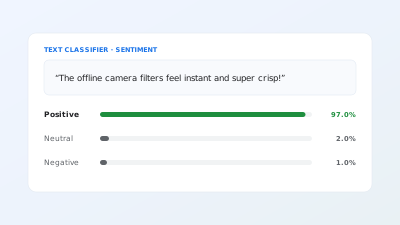
MediaPipe Text Classifier task lets you classify text into a set of defined categories, such as positive or negative sentiment. The categories are defined during the training of the model. This task operates on text data with a machine learning (ML) model as static data and outputs a list of categories and their likelihood scores.
Quickstart
Install the SDK for your platform, initialize the task with a model, and run inference.
Web
import { FilesetResolver, TextClassifier } from "@mediapipe/tasks-text";

const MODEL_URL = "https://storage.googleapis.com/mediapipe-models/text_classifier/bert_classifier/float32/latest/bert_classifier.tflite";

const textFiles = await FilesetResolver.forTextTasks(
  "https://cdn.jsdelivr.net/npm/@mediapipe/tasks-text@latest/wasm"
);
const textClassifier = await TextClassifier.createFromOptions(textFiles, {
  baseOptions: { modelAssetPath: MODEL_URL },
  maxResults: 5,
});

const inputText = "An unforgettable and genuinely moving film!";
const result = textClassifier.classify(inputText);
Android (Kotlin)
import com.google.mediapipe.tasks.core.BaseOptions
import com.google.mediapipe.tasks.text.textclassifier.TextClassifier
import com.google.mediapipe.tasks.text.textclassifier.TextClassifier.TextClassifierOptions

val baseOptions = BaseOptions.builder()
    .setModelAssetPath("bert_classifier.tflite")
    .build()
val options = TextClassifierOptions.builder()
    .setBaseOptions(baseOptions)
    .build()

val textClassifier = TextClassifier.createFromOptions(context, options)

val inputText = "An unforgettable and genuinely moving film!"
val result = textClassifier.classify(inputText)
Android (Java)
import com.google.mediapipe.tasks.core.BaseOptions;
import com.google.mediapipe.tasks.text.textclassifier.TextClassifier;
import com.google.mediapipe.tasks.text.textclassifier.TextClassifier.TextClassifierOptions;
import com.google.mediapipe.tasks.text.textclassifier.TextClassifierResult;

BaseOptions baseOptions = BaseOptions.builder()
    .setModelAssetPath("bert_classifier.tflite")
    .build();
TextClassifierOptions options = TextClassifierOptions.builder()
    .setBaseOptions(baseOptions)
    .build();

TextClassifier textClassifier = TextClassifier.createFromOptions(context, options);

String inputText = "An unforgettable and genuinely moving film!";
TextClassifierResult result = textClassifier.classify(inputText);
iOS
import Foundation
import MediaPipeTasksText

guard let modelPath = Bundle.main.path(forResource: "bert_classifier", ofType: "tflite") else { return }

let options = TextClassifierOptions()
options.baseOptions.modelAssetPath = modelPath
options.scoreThreshold = 0.6

let textClassifier = try TextClassifier(options: options)

let inputText = "An unforgettable and genuinely moving film!"
let result = try textClassifier.classify(text: inputText)
Python
import mediapipe as mp

BaseOptions = mp.tasks.BaseOptions
TextClassifier = mp.tasks.text.TextClassifier
TextClassifierOptions = mp.tasks.text.TextClassifierOptions

model_path = "bert_classifier.tflite"
options = TextClassifierOptions(base_options=BaseOptions(model_asset_path=model_path))

input_text = "An unforgettable and genuinely moving film!"
with TextClassifier.create_from_options(options) as classifier:
    classification_result = classifier.classify(input_text)
Task details
This section describes the capabilities, inputs, outputs, and configuration options of this task.
Features
- Input text processing - Support out-of-graph tokenization for models without in-graph tokenization
- Multiple classification heads - Each head can use its own category set
- Label map locale - Set the language used for display names
- Score threshold - Filter results based on prediction scores
- Top-k classification results - Limit the number of classification results
- Label allowlist and denylist - Specify the categories detected
- String
- Category index: the index of the category in the model outputs
- Score: the confidence score for this category, expressed as a probability between zero and one as floating point value.
- Category name (optional): the name of the category as specified in the TensorFlow Lite Model Metadata, if available.
- Category display name (optional): a display name for the category as specified in the TensorFlow Lite Model Metadata, in the language specified through display names locale options, if available.
Configuration options
This task has the following configuration options:
Web
| Option Name | Description | Value Range | Default Value |
|---|---|---|---|
displayNamesLocale |
Locale code for display names provided in the model metadata, if available. You can add localized labels to custom models with the LiteRT Metadata Writer API. | Locale code | "en" |
maxResults |
Maximum number of top-scored classification results to return (-1 returns all results). |
Integer | -1 |
scoreThreshold |
Prediction score threshold overriding the model metadata default. Classifications lower than this score are rejected. | Float [0.0, 1.0] |
Not set |
categoryAllowlist |
Optional list of allowed category names. Mutually exclusive with categoryDenylist. |
List of strings | Not set |
categoryDenylist |
Optional list of excluded category names. Mutually exclusive with categoryAllowlist. |
List of strings | Not set |
Android
| Option Name | Description | Value Range | Default Value |
|---|---|---|---|
displayNamesLocale |
Locale code for display names provided in the model metadata, if available. You can add localized labels to custom models with the LiteRT Metadata Writer API. | Locale code | "en" |
maxResults |
Maximum number of top-scored classification results to return (-1 returns all results). |
Integer | -1 |
scoreThreshold |
Prediction score threshold overriding the model metadata default. Classifications lower than this score are rejected. | Float [0.0, 1.0] |
Not set |
categoryAllowlist |
Optional list of allowed category names. Mutually exclusive with categoryDenylist. |
List of strings | Not set |
categoryDenylist |
Optional list of excluded category names. Mutually exclusive with categoryAllowlist. |
List of strings | Not set |
iOS
| Option Name | Description | Value Range | Default Value |
|---|---|---|---|
displayNamesLocale |
Locale code for display names provided in the model metadata, if available. You can add localized labels to custom models with the LiteRT Metadata Writer API. | Locale code | "en" |
maxResults |
Maximum number of top-scored classification results to return (-1 returns all results). |
Integer | -1 |
scoreThreshold |
Prediction score threshold overriding the model metadata default. Classifications lower than this score are rejected. | Float [0.0, 1.0] |
Not set |
categoryAllowlist |
Optional list of allowed category names. Mutually exclusive with categoryDenylist. |
List of strings | Not set |
categoryDenylist |
Optional list of excluded category names. Mutually exclusive with categoryAllowlist. |
List of strings | Not set |
Python
| Option Name | Description | Value Range | Default Value |
|---|---|---|---|
display_names_locale |
Locale code for display names provided in the model metadata, if available. You can add localized labels to custom models with the LiteRT Metadata Writer API. | Locale code | "en" |
max_results |
Maximum number of top-scored classification results to return (-1 returns all results). |
Integer | -1 |
score_threshold |
Prediction score threshold overriding the model metadata default. Classifications lower than this score are rejected. | Float [0.0, 1.0] |
Not set |
category_allowlist |
Optional list of allowed category names. Mutually exclusive with category_denylist. |
List of strings | Not set |
category_denylist |
Optional list of excluded category names. Mutually exclusive with category_allowlist. |
List of strings | Not set |
Task output
Each TextClassifierResult contains one Classifications entry per classification head:
| Field | Type / Range | Description |
|---|---|---|
classifications |
Classifications[] |
Per-head classification results (headIndex, headName, categories). |
categories |
Category[] (score in [0.0, 1.0]) |
Ranked sentiment or topic categories (categoryName, index, score). |
Example TextClassifierResult payload
The following example shows the sentiment classification output for the input text "an imperfect but overall entertaining mystery":
{
  classifications: [
    {
      headIndex: 0,
      categories: [
        { index: 0, score: 0.8904, categoryName: "positive" },
        { index: 1, score: 0.1096, categoryName: "negative" }
      ]
    }
  ]
}
Models
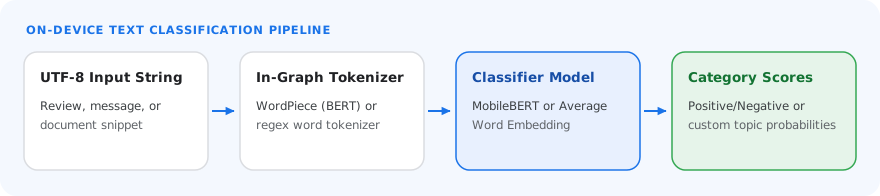
Text Classifier can be used with more than one ML model. Start with the default, recommended model for your target platform when you start developing with this task. The other available models typically make trade-offs between performance, accuracy, resolution, and resource requirements, and in some cases, include additional features.
The pretrained models are trained for sentiment analysis, and predict whether the input text's sentiment is positive or negative. The models were trained on the SST-2 (Stanford Sentiment Treebank) dataset, which consists of movie reviews labeled as either positive or negative. Note that the models only support English. Since they were trained on a dataset of movie reviews, you may see reduced quality for text covering other topic areas.
BERT-classifier model (recommended)
This model uses a BERT-based architecture (specifically, the MobileBERT model) and is recommended because of its high accuracy. It contains metadata that allows the task to perform out-of-graph BERT tokenization.
| Model name | Input shape | Quantization type | Versions |
|---|---|---|---|
| BERT-classifier | [1x128],[1x128],[1x128] | dynamic range | Latest |
Average word embedding model
This model uses an average word-embedding architecture. This model offers a smaller model size and lower latency at the cost of a lower prediction accuracy compared to the BERT-classifier. Customizing this model through additional training is also faster than doing training of the BERT-based classifier. This model contains metadata that allows the task to perform out-of-graph regex tokenization.
| Model name | Input shape | Quantization type | Versions |
|---|---|---|---|
| Average word embedding | 1 x 256 | None (float32) | Latest |
Task benchmarks
Here are the task benchmarks for the whole pipeline based on the preceding pre-trained models. The latency result is the average latency on Pixel 6 using CPU / GPU.
| Model name | Device | CPU latency | GPU latency |
|---|---|---|---|
| Average word embedding | Pixel 6 | 0.14ms | - |
| BERT-classifier | Pixel 6 | 57.68ms | - |